 11
11
Updated 10 July 2026 · By Martín · Affiliate disclosure: we may earn a commission on purchases made through links on this page, at no extra cost to you.
TL;DR — The best padel racket for a beginner in the UK is a round-shaped racket weighing 350–365 g with a soft EVA core, priced between £40 and £90. Our top pick for 2026 is the Bullpadel Indiga (around £64–£70), with the Head Flash 2.0 (~£65) close behind and the Kuikma PR Comfort Soft (~£40) as the best true-budget option. Skip teardrop and diamond shapes until your technique is consistent — they punish off-centre hits.
With the UK now past one million padel players and more than 1,800 courts nationwide, according to the LTA, thousands of people are buying their first racket every month — and most of them are being sold the wrong one. This guide explains what actually matters in a first racket, compares the best beginner options available from UK retailers in 2026, and tells you what to avoid.
A beginner padel racket is a racket designed to maximise forgiveness: a round head shape places the sweet spot in the centre of the face, a soft EVA foam core absorbs off-centre impacts, and a weight of 350–365 g keeps the swing manageable and protects your elbow. In plain terms: your first racket’s job is to help you learn technique, not to win points with power.
Four specs decide everything at this level:
Price-wise, the honest range is £40–£90. Below £40, foam quality drops sharply and rackets can go dead within months. Above £110, you’re paying for stiffness and power features a beginner can’t use yet.
Prices are approximate UK retail at the time of writing (July 2026) and change frequently — always check the current price before buying.
| Racket | Shape | Weight | Core / Face | Approx. price | Best for |
|---|---|---|---|---|---|
| Bullpadel Indiga (PWR/CTR) | Round | 355–365 g | Soft EVA / fibreglass | £64–£70 | Best overall first racket |
| Head Flash 2.0 | Round | ~355 g | Soft foam / fibreglass | ~£65 | Maximum forgiveness |
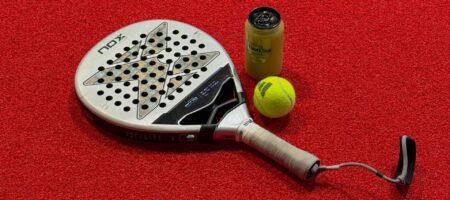
| Nox X-Hero / X-One | Round | 350–360 g | HR3 EVA / fibreglass | ~£60 | Cold-weather outdoor play |
| Kuikma PR Comfort Soft | Round | ~360 g | Soft EVA / fibreglass | ~£40 | Tightest budget / trying padel out |
| Adidas RX Series | Round | ~360 g | EVA / fibreglass-carbon | £70–£85 | Committed beginners |
Bullpadel supplies the official racket of the Premier Padel tour, and the Indiga is its entry point: round shape, centred sweet spot, soft EVA core, and a build quality that survives the wall clips and frame edges of a first season. It does nothing spectacular and everything correctly — which is precisely the assignment. If you buy one racket from this page and play twice a week, expect it to serve you comfortably for 12–18 months before you outgrow it.
The Flash 2.0 is the racket UK coaches hand to complete beginners for a reason: the sweet spot feels enormous, vibration is minimal, and mishits still go over the net. It’s not exciting and nobody will compliment it at the club. It will, however, let you build technique without fighting your equipment — the entire point of a first racket.
Nox’s entry-level workhorse pairs a fibreglass face with an HR3 EVA core that holds its properties well in cooler temperatures — genuinely relevant if your local courts are outdoors and you play through a British winter. (Deciding between court types? See our indoor vs outdoor UK courts guide.)
Decathlon’s house brand delivers all four beginner must-haves — round, soft, light, forgiving — at around £40, a price where most brands compromise on foam. If you’re not yet sure padel will stick, this is the racket that lets you find out cheaply. If you already know you’re hooked, spend the extra £25 on the Indiga; it will last longer and feel better.
A step up in build quality and feel for players who’ve had a few sessions and know they’re staying. The fibreglass-carbon face is slightly crisper than the pure-fibreglass options above while remaining forgiving. A sensible buy if you’re playing weekly from day one.
Once the racket is sorted, footwork is the next upgrade — court-specific shoes matter more than most beginners expect. Our best padel shoes UK guide covers that. And when you’re ready to add your first proper overhead, start with the bandeja before attempting the víbora.
Between £40 and £90. Below £40, foam quality is unreliable; above £110, you’re paying for performance features a beginner can’t use. The £60–£75 bracket (Bullpadel Indiga, Head Flash 2.0) offers the best balance of quality and price in 2026.
No. Padel rackets are solid with a perforated foam-and-composite face and no strings; tennis rackets are strung and built for entirely different ball dynamics. Padel rules — set internationally by the FIP — also limit racket dimensions that tennis frames exceed.
Roughly 12–24 months of regular play (2–3 sessions per week) for a quality £60+ racket. Sub-£40 rackets often go soft in 3–6 months. Most breakages come from hitting walls or fencing, not the ball — a frame protector meaningfully extends lifespan.
350–365 g. Lighter is easier on the arm and faster at the net; heavier adds power a beginner can’t yet control and raises injury risk.
Round, without exception. Its centred sweet spot forgives off-centre contact. Move to teardrop only after 6–12 months of consistent play — our racket shapes comparison explains when and why.
The numbers say growth: the UK passed one million players and 1,800+ courts in 2026, with participation roughly doubling year on year — full figures on our UK Padel Statistics 2026 page.