Padel Injuries: What the Research Says and How to Avoid Them (UK Guide)
TL;DR: Padel causes about 3 injuries per 1,000 hours of training and 8 injuries per 1,000 matches, and roughly 40% of players pick up at least one injury a year (Dahmen et al., BMJ Open Sport & Exercise Medicine, 2023). The elbow is the single most injured area, followed by the knee, shoulder and lower back. Most upper-body damage is tendon-related; most lower-body damage is ligament-related. One of the few modifiable risk factors identified in the research is racket weight — frames above 350g are associated with higher injury rates.
Padel has a reputation for being gentle. It is easier on the body than squash and less punishing on the shoulder than tennis serving, and that reputation brings a lot of people to the sport in their thirties and forties who have not played anything competitive in years.
The reputation is only half right. Padel’s injury profile is real, it is well documented, and it is concentrated in a small number of predictable places. This guide covers what the published research actually found, which is a different thing from what most padel content claims.
What the research actually found
Two reviews are worth knowing about, because almost everything else written on this topic traces back to them.
Dahmen et al. (2023) published a systematic review in BMJ Open Sport & Exercise Medicine pooling eight studies and 2,022 players. Navarro-Ledesma et al. (2026) published a broader scoping review in Applied Sciences covering 14 studies and 3,581 players.
Their headline numbers:
| Measure | Finding | Source |
|---|---|---|
| Training injury rate | 3 per 1,000 hours | Dahmen 2023 |
| Match injury rate | 8 per 1,000 matches | Dahmen 2023 |
| Players injured per year | ~40% | Navarro-Ledesma 2026 |
| Overall prevalence range | 40–95% | Both |
| Coaches injured in past year | 76% | Navarro-Ledesma 2026 |
That prevalence range is wide because studies define “injury” differently — some count anything that caused a missed session, others count any pain lasting more than a week. Treat 40–95% as a signal that injuries are common, not as a precise figure.
Note that the two incidence figures use different denominators — one per 1,000 training hours, one per 1,000 matches — so they cannot be compared directly. What the wider literature does identify is that competitive play carries the mechanisms behind most padel injuries: late, off-balance, reactive movements. The lunge you should not have gone for, the overhead you took a step too late.
Where padel injuries happen
Dahmen et al. rank the anatomical sites as elbow, then knee, then shoulder, then lower back. Navarro-Ledesma et al. break it down by limb: elbow first in the upper body followed by the shoulder, knee first in the lower body followed by the ankle.
| Region | Rank (Dahmen 2023) | Dominant injury type |
|---|---|---|
| Elbow | 1st | Tendon — lateral epicondylitis |
| Knee | 2nd | Ligament, including ACL |
| Shoulder | 3rd | Tendon — rotator cuff, impingement |
| Lower back | 4th | Muscular |
| Ankle | 2nd lower limb (Navarro-Ledesma) | Ligament — sprains |
There is also a sex difference the research is clear about: women show higher injury incidence rates, men show higher overall prevalence, and women showed markedly higher upper-limb ligament and muscle injury prevalence — 44.6% versus 8.2% in men (Navarro-Ledesma 2026).
Padel elbow: the one you are most likely to get
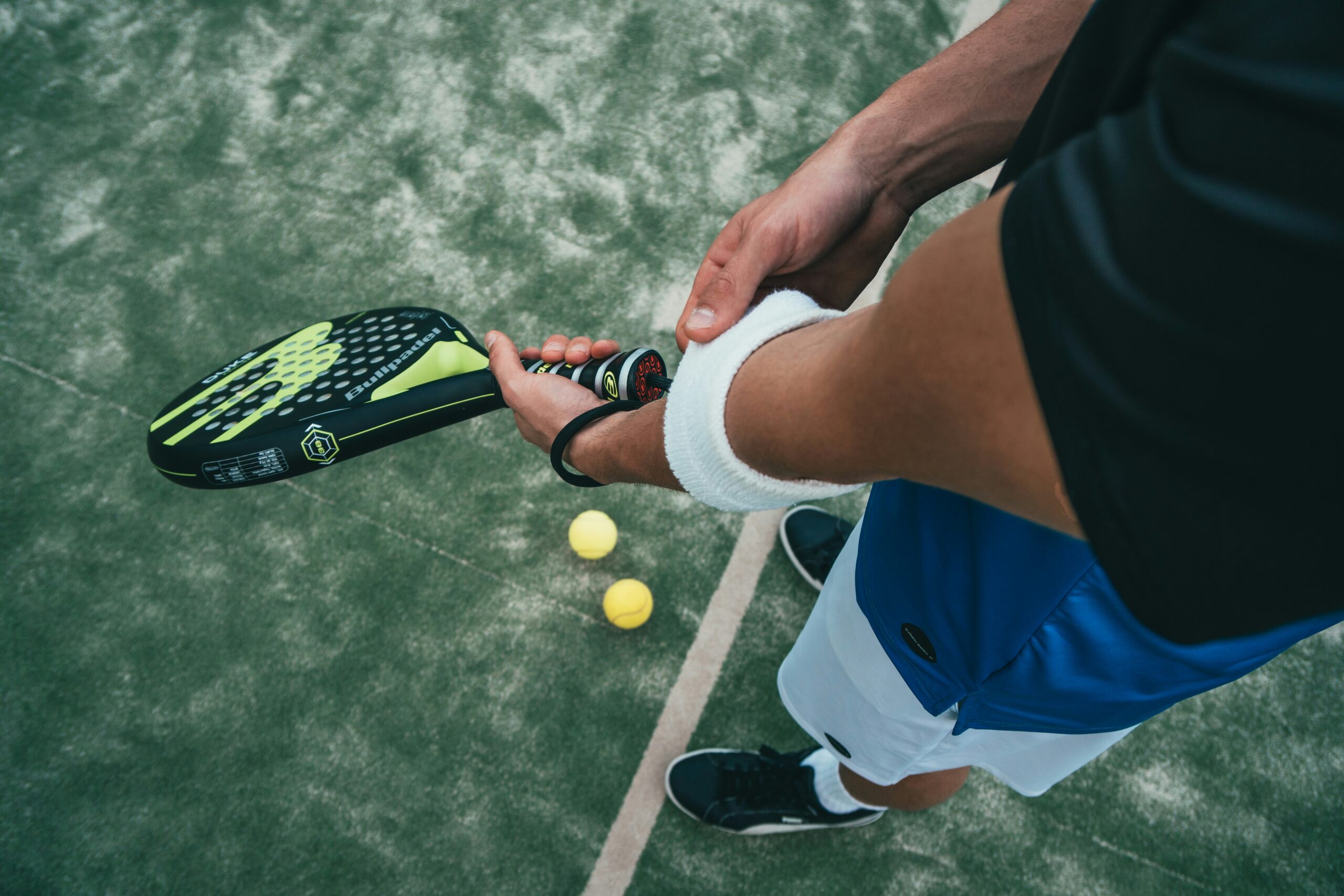
Lateral epicondylitis — “padel elbow” or “tennis elbow” — is the most frequently reported padel injury in every study reviewed. The research identifies the extensor carpi radialis brevis tendon as the structure most often involved.
This is the small tendon on the outside of your elbow that controls wrist extension. In padel it takes load on every backhand, every block, and every off-centre contact, because a mis-hit sends vibration straight through the wrist into the forearm.
What drives it:
- Off-centre contact — the single biggest contributor. Every ball hit outside the sweet spot transmits shock into the forearm
- Gripping too tightly, which is what beginners do when the ball is coming faster than they can process
- A racket that is too heavy or too head-heavy for your strength
- Volume increases — going from once a week to three times a week in a fortnight
What actually helps:
- Forearm strengthening and endurance work, which the research specifically identifies as effective. Wrist extensions and eccentric loading, not just stretching
- A larger sweet spot: round-shaped rackets with a lower balance point have the most forgiving sweet spot
- Loosen your grip between points. A death grip through a two-hour session is a training load in itself
- Fresh overgrip. A slick grip makes you squeeze harder without noticing
If your elbow hurts when you shake hands, lift a kettle, or open a door, that is lateral epicondylitis and it is not going to clear up by playing through it.
Racket weight is a modifiable risk factor
This is the most practically useful finding in the recent literature, and it barely appears in padel buying guides.
Navarro-Ledesma et al. (2026) list racket weight above 350g as a factor associated with higher injury rates, alongside playing volume, technical level and fatigue.
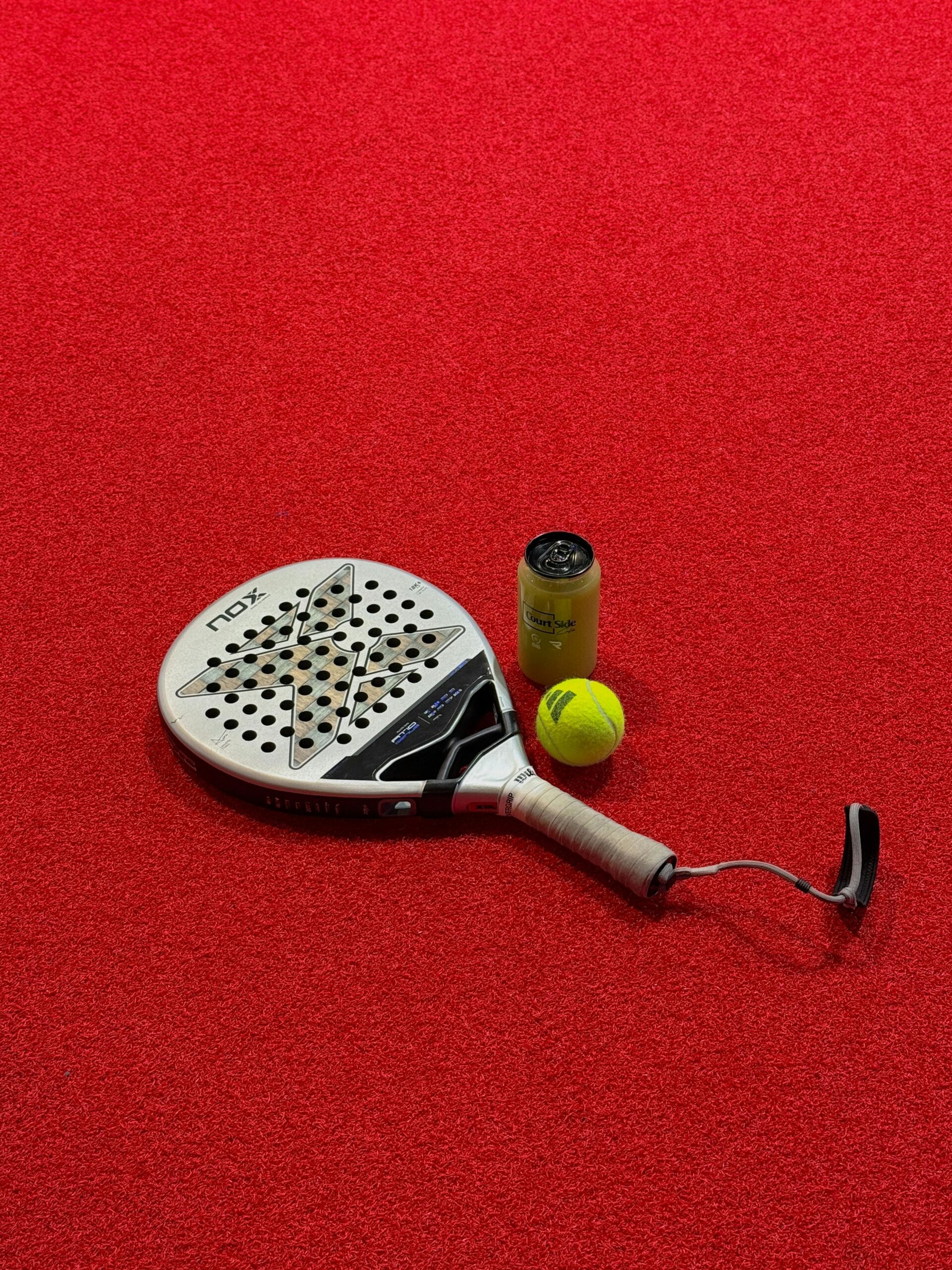
This puts a lot of standard beginner advice in an awkward position. Most retailer guides recommend 340–360g for new players, on the reasoning that a heavier frame is more stable against fast balls. That range straddles the threshold the injury research flags.
The reasonable reading: if you are new, deconditioned, returning from a break, or have any history of elbow or shoulder trouble, stay at the lower end — 350g or below. Stability is worth something, but not at the cost of the joint that padel injures most often. See our padel racket buying guide for how weight interacts with shape and balance.
Shoulder: the overhead problem
Padel involves far more overhead shots per hour than tennis. The bandeja, víbora and smash all load the shoulder in an overhead position, and unlike tennis you play them repeatedly through a point rather than once per serve.
The research points to fatigue and late positional adjustment as key mechanisms — specifically, hitting overheads when you have not moved your feet into position in time, so the shoulder does work the legs and trunk should have done.
Prevention:
- Footwork under lobs. The bandeja is a footwork shot before it is an arm shot — see our bandeja technique guide
- Rotator cuff and scapular stability work, twice a week, ten minutes
- Stop hitting flat smashes when you are tired. Fatigue is when the mechanics break down
Knee and ankle: the ligament injuries
Lower-limb padel injuries are predominantly ligamentous. The knee and ankle are the most affected joints, with ankle sprains commonly documented and ACL injuries appearing in the literature.
The mechanism is padel-specific: a 10m × 20m court means constant short accelerations, sudden stops and direction changes in a confined space, often reacting to a ball off the glass rather than moving on your own terms.
Prevention that the research supports:
- Neuromuscular control work — single-leg balance, hop-and-stick landings, lateral bounds. This is the intervention with the best evidence across court sports
- Progressive exposure to playing volume. Both reviews identify rapid volume increase as a risk factor. Adding a third weekly session should happen over a month, not a week
- Court-appropriate shoes. Padel-specific soles are built for lateral grip on artificial turf; running shoes are built to go forwards and will roll an ankle
A warm-up that matches the injury profile
Ten minutes, targeting what actually gets hurt.
- Three minutes light movement — jog the court, side shuffles, gradually increasing
- Ankle and knee prep — 10 lateral bounds each direction, 10 single-leg hop-and-stick landings per leg
- Hip and trunk — leg swings, 10 forward/back and 10 side-to-side each leg
- Shoulder — arm circles, then 15 band external rotations per arm
- Forearm — 15 wrist extensions per arm, then squeeze and release the grip 10 times
- On court — five minutes of easy volleys before hitting a single overhead
The forearm and shoulder components are the ones people skip, and they target the two most injured regions in the sport.
When to stop and see a physio
Book an appointment rather than waiting if you have:
- Elbow pain during everyday grip tasks — kettles, doors, handshakes
- Shoulder pain that wakes you at night or stops you reaching overhead
- Any ankle or knee that gave way, swelled within an hour, or will not take full weight
- Any pain that has not improved after two weeks of reduced play
Padel injuries are mostly soft-tissue and mostly respond well to early loading. The reviews specifically note that early mobilisation beats prolonged immobilisation — resting completely for six weeks is generally the wrong answer for tendon problems.
Frequently asked questions
How common are padel injuries?
About 40% of players sustain at least one injury per year. The measured rates are 3 injuries per 1,000 hours of training and 8 per 1,000 hours of matchplay (Dahmen et al., 2023).
What is the most common padel injury?
Lateral epicondylitis — padel elbow. Every study in both reviews identified the elbow as the most frequently injured region, with the extensor carpi radialis brevis tendon most often involved.
Is padel safer than tennis or squash?
The comparative evidence is thin and the reviews caution against strong claims. Padel’s injury rates are broadly comparable to other racket sports, with a different distribution — relatively more elbow, relatively less serving-shoulder load than tennis.
Does racket weight affect injury risk?
The 2026 scoping review lists frames above 350g among factors associated with higher injury rates. If you have any elbow or shoulder history, stay at or below 350g.
Should I wear a mouthguard?
Dental trauma in padel is uncommon but does happen, usually from a partner’s racket in a doubles collision or a ball at close range. A boil-and-bite guard costs under £10 and is reasonable if you play mixed-ability social doubles where court awareness is patchy.
How long does padel elbow take to heal?
It varies widely and depends on whether you keep playing. Tendon problems respond to progressive loading rather than rest. If grip tasks hurt in daily life, see a physiotherapist rather than self-managing.
Sources
- Dahmen J, Emanuel KS, Fontanellas-Fes A, Verhagen E, Kerkhoffs GMMJ, Pluim BM. Incidence, prevalence and nature of injuries in padel: a systematic review. BMJ Open Sport & Exercise Medicine, 2023. DOI: 10.1136/bmjsem-2023-001607
- Navarro-Ledesma S, et al. Epidemiology, Incidence, Prevalence, and Treatment of Injuries in Padel: A Scoping Review. Applied Sciences, 2026;16(6):2680. DOI: 10.3390/app16062680
- Lawn Tennis Association, padel participation data, May 2026
This article summarises published research and is not medical advice. If you are injured, see a physiotherapist or doctor.