 11
11
TL;DR: Padel is doubles-only, played on an enclosed court 10m wide by 20m long, where the ball stays live off the glass walls. You serve underarm after one bounce. Scoring is the same as tennis. In Britain there are now 1,825 courts at 551 venues, and the LTA puts an average off-peak booking at £27 per court per hour — £7 per person in a doubles booking. Most clubs rent rackets, so your first session needs trainers and nothing else.
Britain went from 15,000 padel players in 2019 to one million by May 2026 (LTA). Whatever brought you here — a friend’s invitation, a court appearing at your local club, or the fact that it looks easier than tennis — the useful question is what actually happens when you walk onto a court for the first time.
This guide answers that. Not the history of the sport, not why it is growing: what you need to know before your first 90 minutes.
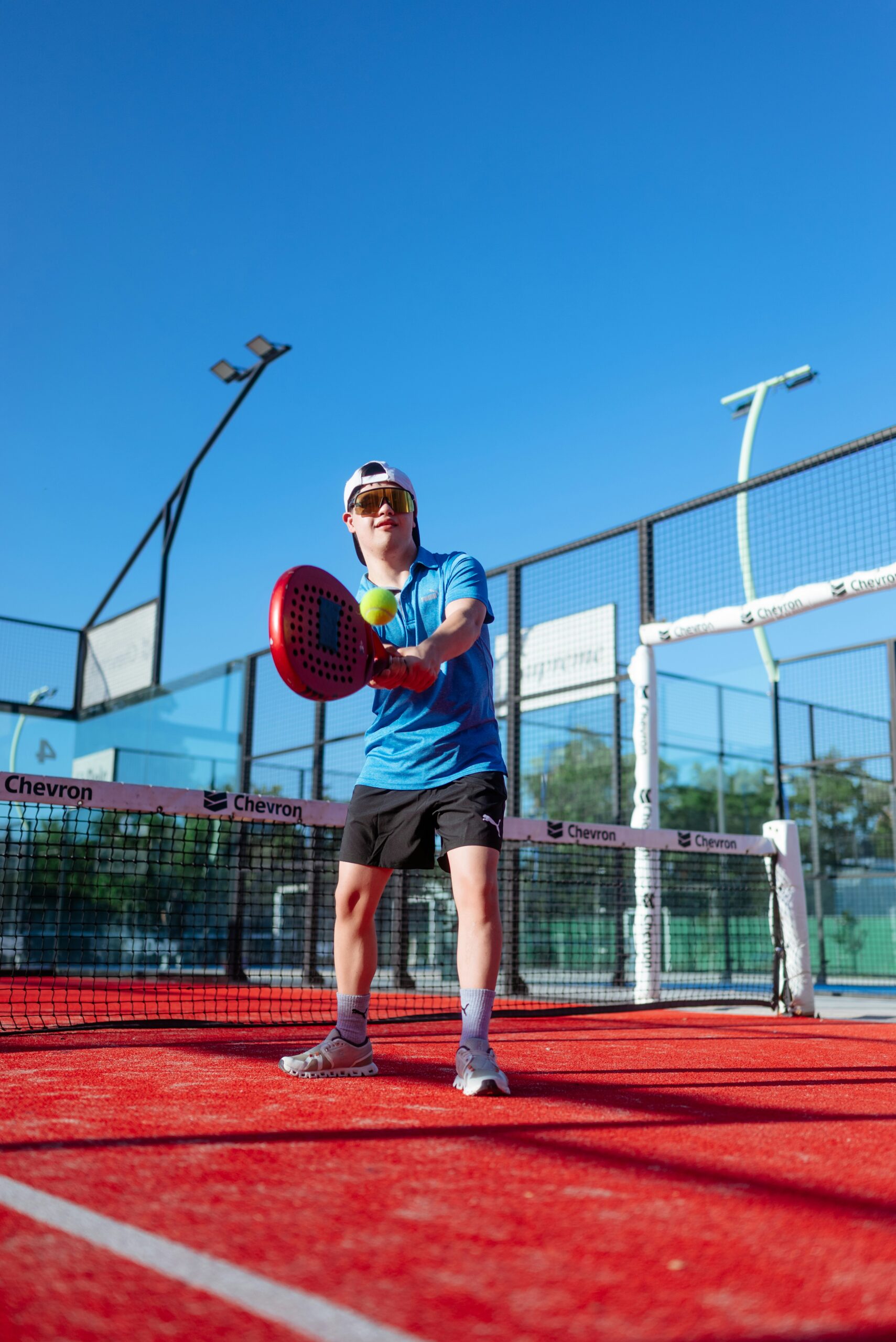
Padel is a doubles racket sport played on an enclosed court where the ball can be played off the walls. The court is 10 metres wide and 20 metres long, divided by a net, and surrounded by glass and mesh walls that keep the ball in play (International Padel Federation, rules effective 1 January 2026).
The three things that make it different from tennis:
The rest — scoring, the net, the general idea of hitting the ball over it — will be familiar if you have played any racket sport.
You do not need the full rulebook to play. You need these.
| Rule | What it means |
|---|---|
| Serve underarm, below the waist | Bounce the ball, hit it at or below waist height, one foot behind the service line |
| Serve must land diagonally | Into the opposite service box, like tennis. Two attempts |
| One bounce, then you must return it | Same as tennis — the ball cannot bounce twice on your side |
| Walls are live after the bounce | If the ball bounces on your side then hits your back wall, it is still in play. Hit it before the second bounce |
| Direct into the wall is out | If your shot hits the opponent’s wall before their ground, you lose the point |
That last pair is the one beginners get wrong, so to be explicit: the ball must bounce on the floor of your opponent’s court before it touches any wall. Your own back wall is your friend. Their walls are not a target.
Scoring is 15, 30, 40, game — identical to tennis. Six games wins a set, with a tiebreak at 6–6. Some clubs use a “golden point” at deuce, where a single point decides the game instead of playing advantages. Our padel rules guide covers the full set.
The LTA reported an average off-peak court booking at £27 per hour — £7 per person based on a doubles booking (LTA, March 2026). Courts are booked by the hour and split four ways, so what you actually pay depends on venue and time:
Peak-time courts in city centres book out days ahead. Most UK venues use Playtomic or their own app.
Genuinely short list:
That last point matters. Racket choice depends on how you actually play, which you do not know yet. Rent for three or four sessions first, then read our racket buying guide.
Minutes 0–10 — warm up properly. Padel injures the elbow more than any other joint, and the ankle is second among lower-limb injuries. Five minutes of movement and a few forearm and shoulder rotations is worth it. Our injuries guide has a ten-minute routine.
Minutes 10–25 — hit without keeping score. Volleys from the net, then groundstrokes from the back. Get a feel for how little the solid racket gives you compared to a strung one.
Minutes 25–40 — learn the back wall. This is the skill that separates a first-timer from someone who has played twice. Stand near the back glass and have someone feed balls past you. Let them bounce, hit the glass, and come back to you. Wait for them. Your instinct will be to rush; the ball comes back slower than you expect.
Minutes 40–90 — play points. You will lose most of them. That is fine.
Running away from the back wall. The ball comes off the glass towards the middle of the court. Standing still and letting it come to you works better than backing up.
Smashing everything. Padel’s enclosed court means a hard flat smash frequently rebounds off the back glass and comes straight back at you. Placement beats power at every level, and it beats it most at beginner level.
Gripping too tight. A tight grip on a solid racket transmits shock into your forearm and is one of the mechanisms behind padel elbow. Hold it as if you were carrying a bird.
Standing on the baseline like it is tennis. The team at the net controls the point in padel. Getting forward is the whole tactical game.
Hitting the ball straight into your opponents’ wall. Covered above, and it is the most common lost point of a first session.
There are 1,825 padel courts across 551 venues as of May 2026 — up from 69 courts in 2020. Roughly two-thirds of padel players in Britain also play tennis, so many courts sit at existing tennis clubs.
Most venues run beginner sessions or “padel socials” that mix people of similar levels. These are the fastest way in, because padel is doubles and turning up alone is otherwise awkward. Our guide to starting padel in the UK covers finding a club and booking a court.
Do I need to be fit to play padel?
No. Padel is played in a small space and rallies are short. It is more forgiving than squash and less physically demanding than singles tennis. Build up your weekly volume gradually — rapid increases are a documented injury risk factor.
Is padel easier than tennis?
The first hour is easier. The court is smaller, the racket is shorter, and the walls give you a second chance at balls that would be winners in tennis. The ceiling is just as high.
Can you play padel with two people?
Padel is designed for four. Singles courts exist but are rare in the UK and the game changes significantly on them.
How long does a padel session last?
Courts are usually booked in 60 or 90-minute blocks. Ninety minutes is standard for four players.
What should I wear?
Anything you would wear to the gym, plus court-appropriate shoes. There is no dress code at UK venues.
Do I need lessons to start?
No, but one group lesson before your first social session is a good investment — mainly to learn the back wall, which is not intuitive and is hard to pick up by yourself.